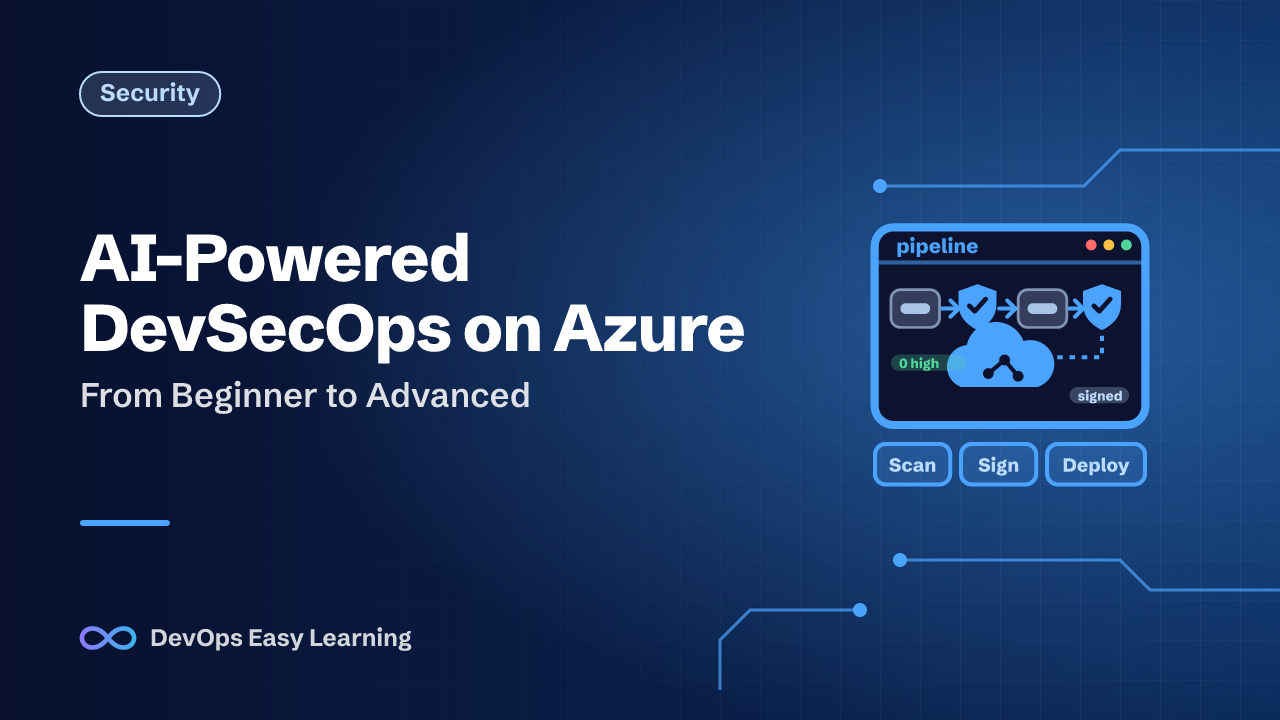
AI-Powered DevSecOps on Azure: From Beginner to Advanced
Secure a real application from Git to AKS: threat modeling, scanning, secrets, Kubernetes policy, PKI, supply chain and runtime, with AI as a careful reviewer.
Created by DevOps Easy Learning · Designed by Tia
Launch price $99.99
This course isn’t open yet, so there is nothing to buy or enrol in. Press Notify me to hear when it opens.
No payment, no account needed. One email on launch day.
The plan
- 40 modules, 217 lessons in the plan
- 6 of 217 lessons recorded so far
- One email when it opens, if you ask for it
What you’ll learn
- Threat-model an application and turn threats into tests and backlog items
- Find and fix vulnerabilities in code, dependencies, containers and infrastructure as code, and prove each fix with a scan
- Manage secrets with OpenBao and External Secrets Operator and respond to a leaked secret
- Harden Kubernetes and AKS with RBAC, Pod Security, network policies, Kyverno and Gatekeeper
- Run PKI and TLS properly: certificates, cert-manager, mTLS and expiry monitoring
- Secure the supply chain and the pipeline with SBOMs, VEX, signing, provenance and approvals
- Secure Azure identity, secrets, certificates, monitoring and backups
- Use AI safely as a security reviewer and secure AI applications and agents
Course content
The whole course is planned below. Lessons marked Coming soon are on the way; the others are ready to watch.
- Course introduction: AI-Powered DevSecOps on AzureSee the whole curriculum, ShopStack and the capstone. Premium intro (§4a): real footage of every module.Coming soon
- Your Azure training account, safely: budgets, MFA and cleanupSet budgets, MFA and the cleanup habit before any lab. Budget alert and tagging policy.Coming soon
- Meet ShopStack: the insecure app you will secureRun the deliberately insecure ShopStack locally and list what is wrong with it. docker compose up; tour web, API, worker, Postgres, Redis; spot a leaked key and a root container.Coming soon
- Set up your lab: Docker, VS Code, kind and your AI assistantInstall the lab toolchain on Windows (WSL2), macOS or Linux, with a VM alternative. Install and verify every tool; Ollama model or BYO key in .env (never committed).Coming soon
- The security debt scoreboard: every scanner, one numberRun the scoreboard and read the first findings by category. make score: secrets, code, deps, containers, IaC, Kubernetes; baseline saved.Coming soon
- Working safely: authorized labs, synthetic data and AI with sanitized inputFollow the lab's legal and safety rules and the AI redaction habit. What we test and where; the redact script before any AI call.Coming soon
- DevOps and DevSecOps: what changes and whyExplain DevSecOps as shared responsibility across the pipeline. ShopStack's pipeline drawn with the missing security steps.Coming soon
- The secure SDLC: shift left and shift rightPlace each security practice in the lifecycle. Animated lifecycle with ShopStack's findings placed on it.Coming soon
- CIA, defence in depth and Zero Trust in a real systemApply CIA, layered defences and Zero Trust to ShopStack. Map each layer of ShopStack and the controls it lacks.Coming soon
- Who owns what: engineers, security and the businessAssign security responsibilities realistically. RACI for ShopStack's findings.Coming soon
- AI as a security teammate: what it can and can't doUse AI to review a Dockerfile and confirm with a scanner. AI review of ShopStack's Dockerfile, Hadolint confirms two of its five claims.Coming soon
- Threat modeling: thinking like an attacker, defensivelyExplain why and when to threat model. Four questions: what are we building, what can go wrong, what do we do, did we do well.Coming soon
- Draw ShopStack's data flows and trust boundariesBuild a DFD with trust boundaries. Threat Dragon diagram of ShopStack.Coming soon
- STRIDE on ShopStack, with AI drafting and humans decidingProduce and review a STRIDE threat list. AI draft vs team review: kept, changed, rejected.Coming soon
- From threats to backlog: security requirements and abuse casesTurn threats into tickets, requirements and tests. Three threats become user stories with acceptance tests.Coming soon
- CVE, CWE, CVSS, EPSS and KEV: prioritising what mattersPrioritise findings using CVSS, EPSS and the KEV list. Rank ten real CVEs from ShopStack's dependencies.Coming soon
- SAST, DAST, SCA, IaC and secret scanning: which finds whatChoose the right scanner for each risk. Map each ShopStack finding to the scanner that catches it.Coming soon
- SBOM and VEX: knowing what's inside and what really affects youExplain SBOM formats and how VEX reduces noise. One SBOM, one VEX statement, the scan result before and after.Coming soon
- OWASP, CIS, NIST SSDF, SLSA and OpenSSF: which framework for whatUse the right framework for code, systems, process and supply chain. Framework map for ShopStack.Coming soon
- Security gates, exceptions and risk acceptanceDesign gates and a documented exception process. Exception record with owner and expiry.Coming soon
- Shared responsibility on AzureKnow what Azure secures and what you secure. Responsibility map for ShopStack on Azure.Coming soon
- Entra ID and Azure RBAC least privilegeAssign least-privilege roles. Custom role and scope.Coming soon
- Managed identities instead of secretsUse managed identities. App reads storage with no key.Coming soon
- Network security: NSGs, private endpoints and firewallsIsolate network paths. Private endpoint for Key Vault.Coming soon
- Activity logs and Azure PolicyAudit and enforce configuration. Policy denies a public storage account.Coming soon
- Conditional Access, MFA and privileged access for peopleProtect human admin access. Conditional Access and PIM overview.Coming soon
- The OWASP Top 10, found in ShopStackRecognise the Top 10 categories in real code. Each category located in ShopStack.Coming soon
- Injection and input validation: fix it with a testFix SQL injection with parameterised queries and validation. Failing test, the fix, the test passes, the scanner agrees.Coming soon
- Broken access control and IDOREnforce object-level authorisation. Another user's order blocked, with a test.Coming soon
- Authentication, sessions and password storageStore passwords with a modern hash and secure sessions. MD5 replaced by Argon2id; cookie flags set.Coming soon
- Security misconfiguration and security headersHarden defaults and add security headers. ZAP baseline before and after.Coming soon
- AI-assisted secure code review, proved by testsUse AI review on a pull request and verify each claim. AI comments vs test results vs Semgrep.Coming soon
- Repository security settings, rulesets and branch protectionProtect the main branch and require reviews and checks. GitHub rulesets on the ShopStack repo.Coming soon
- CODEOWNERS and approvals for sensitive pathsRoute security-sensitive changes to the right reviewers. CODEOWNERS for infra/ and auth/.Coming soon
- Find leaked secrets with Gitleaks, in history and before commitDetect secrets in history, pre-commit and CI. The leaked Stripe-style test key found in commit 12.Coming soon
- A secret leaked: revoke, rotate, rewrite historyRun the leaked-secret playbook end to end. Revoke the key, rotate, git filter-repo, force-push in the lab repo, verify.Coming soon
- Signed commits with gitsign and SSH signingSign commits and require signatures. Verified badge, unsigned commit rejected.Coming soon
- AI-assisted pull request security reviewAdd an AI security review comment to pull requests. AI comment on a risky PR; human decision recorded.Coming soon
- SAST explained, and SonarQube editions comparedExplain SAST and choose a SonarQube edition honestly. Community Build vs commercial editions table.Coming soon
- Run SonarQube locally and scan ShopStackDeploy SonarQube in Docker and scan the project. First analysis: bugs, smells, security hotspots.Coming soon
- Quality gates in GitHub ActionsFail a pull request on a quality gate. Gate blocks a PR, the fix passes it.Coming soon
- Semgrep rules, and how it compares with SonarQubeWrite and run a custom Semgrep rule. Rule catches ShopStack's unsafe pattern.Coming soon
- AI explains findings and proposes fixes; the rescan decidesUse AI to triage SAST findings and verify. Five findings: three real, one false positive, one needs a person.Coming soon
- Third-party risk, typosquatting and dependency confusionExplain how dependencies become attack paths. A typosquatted package name caught by review.Coming soon
- Scan dependencies with Trivy and GrypeScan the repo and compare two scanners. Same project, two reports, why they differ.Coming soon
- OWASP Dependency-Check for Java and .NET projectsRun Dependency-Check and read its report. Report on ShopStack's worker.Coming soon
- Automated updates with approval workflowsConfigure Renovate with grouping and approvals. Renovate PRs, tests, a human merges.Coming soon
- Defensive DAST with OWASP ZAP in an isolated labRun a ZAP baseline and authenticated scan against your own lab app. ZAP finds missing headers and a reflected input.Coming soon
- Centralise and prioritise findings with AIMerge results and rank them. AI ranked list checked against EPSS/KEV.Coming soon
- The container attack surfaceExplain what isolation containers do and don't give. Root in a container vs on the host, shown safely in the lab.Coming soon
- A secure Dockerfile: multi-stage, non-root, minimal, pinned by digestRewrite ShopStack's Dockerfile securely. Image size and findings before/after.Coming soon
- Lint Dockerfiles with HadolintAdd Hadolint locally and in CI. Hadolint rules failing then passing.Coming soon
- Build-time secrets without leaking them into layersUse BuildKit secrets instead of ARG/ENV. docker history shows the old leak, the new build is clean.Coming soon
- Runtime hardening: read-only, capabilities, limits and the Docker socketRun containers with least privilege. compose hardened: read_only, cap_drop, no-new-privileges, limits.Coming soon
- Scan images with Trivy and fix what mattersScan, fix and rescan images. Base image swap removes most CVEs.Coming soon
- Registry security and AI-assisted configuration reviewSecure a registry and review compose with AI. AI review of compose, scanner confirms.Coming soon
- Secrets and their lifecycleClassify secrets and their lifecycle. ShopStack's secrets inventory.Coming soon
- Environment variables, files and why Base64 is not encryptionSpot weak secret handling. Decode a 'secret' Kubernetes manifest in one command.Coming soon
- Central storage, short-lived credentials and rotationExplain central stores, leases and rotation. Static vs dynamic credentials timeline.Coming soon
- Log redaction and auditingRedact secrets from logs before storage and AI. Redaction filter tested on ShopStack logs.Coming soon
- Terraform state risks and an encrypted remote backendProtect state with encryption, locking and access control. Secrets visible in local state, then a protected backend.Coming soon
- Sensitive variables and outputsKeep secrets out of plans and outputs. sensitive = true and ephemeral values.Coming soon
- Scan IaC with Checkov and Trivy configScan Terraform and fix findings. Open security group and public bucket fixed.Coming soon
- Scan Helm charts and Kubernetes manifestsScan rendered charts. Checkov on the ShopStack chart.Coming soon
- Infrastructure gates and AI-assisted remediationGate merges on IaC policy. PR blocked, AI fix, gate passes.Coming soon
- Encrypted remote state with locking (Storage + Entra auth)Protect state in the cloud. State bucket/container with encryption and access control.Coming soon
- GitHub Actions federated credentials for TerraformRemove long-lived cloud keys from CI. Plan runs with short-lived credentials.Coming soon
- A secure network moduleBuild a reviewed network module. Module with secure defaults.Coming soon
- Custom Checkov policies for AzureEnforce your own rules. Custom check blocks a risky change.Coming soon
- OpenBao and Vault: architecture and licensingExplain the architecture and the BSL vs MPL difference. Licence comparison and why the labs use OpenBao.Coming soon
- From dev server to a secure lab installInstall OpenBao with TLS and unseal. Dev mode dangers, then a proper install.Coming soon
- Authentication methods and policiesGrant least-privilege access. AppRole and a policy that denies everything else.Coming soon
- KV secrets, versions and rollbackStore and version ShopStack secrets. Roll back a bad secret version.Coming soon
- Dynamic database credentials for PostgresIssue short-lived database users. Each API start gets its own expiring user.Coming soon
- Audit logs, rotation, backup and recoveryAudit access and recover from backup. Audit log read; snapshot restore.Coming soon
- Production architecture: HA, auto-unseal and Kubernetes authPlan a production deployment. Reference architecture diagram.Coming soon
- Key Vault: secrets, keys and certificatesUnderstand Key Vault objects. Vault tour.Coming soon
- Key Vault access with RBAC and managed identitiesRestrict secret access. Only the API identity can read.Coming soon
- Rotation and auditingRotate and audit secrets. Rotation and diagnostic logs.Coming soon
- Move ShopStack's secrets into Key VaultMigrate secrets. No secret left in env files.Coming soon
- Cryptography foundations: keys, hashes and signaturesExplain symmetric, asymmetric, hashing and signatures. Animated key exchange and signature check.Coming soon
- PKI: root and intermediate CAs, chains, CSRs and SANsRead a certificate chain and a CSR. Chain from leaf to root explained.Coming soon
- TLS, HTTPS and mutual TLSExplain server authentication and mTLS. Handshake animation; TLS 1.2 vs 1.3.Coming soon
- Certificate formats: PEM, DER, CRT, PKCS#12Convert formats and protect private keys. Same certificate in four formats.Coming soon
- Inspect and validate certificates with OpenSSLDiagnose expiry, hostname mismatch and missing chains. Three broken synthetic certificates fixed.Coming soon
- Public vs private CAs and self-signed certificatesChoose the right trust model. Trust boundaries for ShopStack.Coming soon
- Let's Encrypt, ACME and cert-managerIssue certificates automatically. Issuer, ClusterIssuer and Certificate with the staging ACME server.Coming soon
- Ingress TLS, internal TLS and OpenBao PKISecure ingress and service-to-service traffic. OpenBao PKI issues internal certificates via cert-manager.Coming soon
- Inventory, renewal, revocation and expiry monitoringTrack and renew certificates. Expiring certificate alert.Coming soon
- AI-assisted TLS troubleshooting and n8n expiry alertsUse AI on sanitized errors and automate alerts. AI diagnosis, openssl proves it; Mattermost alert at 30 days.Coming soon
- Key Vault certificates and issuersIssue and renew certificates. Certificate with auto-renewal.Coming soon
- TLS on Application Gateway and HTTPS on Front DoorTerminate TLS securely. Managed certificate and HTTPS redirect.Coming soon
- Azure DNS validation and custom domainsValidate domains. Domain validated.Coming soon
- AKS ingress TLS with Key VaultSecure AKS ingress. Certificate from Key Vault via CSI.Coming soon
- Certificate inventory and expiry monitoringMonitor expiries. Event Grid to n8n alert.Coming soon
- The Kubernetes attack surface and the API serverExplain the main attack paths defensively. Cluster components and their exposure.Coming soon
- Authentication, authorization and RBACWrite least-privilege Roles and bindings. kubectl auth can-i before and after.Coming soon
- ServiceAccounts and token hygieneLimit and scope workload identities. automountServiceAccountToken off, bound tokens.Coming soon
- Pod Security Standards and AdmissionEnforce baseline and restricted profiles. Privileged pod rejected.Coming soon
- securityContext, non-root, seccomp and AppArmor/SELinux conceptsHarden workloads. ShopStack pods run restricted.Coming soon
- Namespaces, quotas and resource limitsIsolate and bound workloads. A runaway pod contained.Coming soon
- Audit logging, node and control-plane security, upgradesPlan auditing and upgrades. Audit policy and an upgrade checklist.Coming soon
- NetworkPolicies and default denyApply default-deny and allow only needed flows. Connectivity matrix before/after.Coming soon
- Namespace isolation and egress controlRestrict egress. Worker can't reach the internet.Coming soon
- Cilium policies and Hubble visibilityUse L7-aware policies and observe flows. Hubble shows a dropped request.Coming soon
- DNS and ingress securitySecure ingress and DNS. Ingress hardening checklist.Coming soon
- mTLS and service mesh conceptsExplain when a mesh is worth it. mTLS between services, options compared.Coming soon
- Kubernetes Secrets: Base64, etcd encryption and RBACExplain what native Secrets protect. Read a Secret with the wrong RBAC, then fixed.Coming soon
- Native, CSI driver, SOPS, Sealed Secrets and ESO comparedChoose a secret delivery pattern. Decision table; ESO syncs, CSI mounts.Coming soon
- ESO architecture: SecretStore and ClusterSecretStoreInstall ESO and connect a store. ClusterSecretStore to OpenBao.Coming soon
- ExternalSecret with OpenBao: sync, refresh and rotationSync and rotate secrets. Rotate in OpenBao, pod picks it up.Coming soon
- Namespace isolation and RBAC for ESOPrevent cross-namespace secret access. Team A can't read Team B's store.Coming soon
- Troubleshooting ESODiagnose common sync failures. Three broken ExternalSecrets fixed.Coming soon
- AKS cluster access with Entra ID and Kubernetes RBACControl who can reach the cluster. Entra group bound to a Role.Coming soon
- Azure Workload IdentityGive pods least-privilege Azure access. Pod reads one storage container only.Coming soon
- ESO with Key Vault, the CSI driver, and ASOSync or mount secrets; know what ASO does. ExternalSecret from Key Vault; ASO manages resources, ESO syncs secrets.Coming soon
- Troubleshooting workload identityFix federation errors. Wrong audience and subject fixed.Coming soon
- Admission control and the policy lifecycleExplain admission and audit vs enforce. Request flow through admission.Coming soon
- Kyverno: install and your first validate policyEnforce a validate policy. Unlabelled deployment rejected.Coming soon
- Kyverno: approved registries, non-root, resources, mutate and generateApply practical policies. ShopStack passes, a bad manifest fails.Coming soon
- Kyverno: image signature verification and policy reportsVerify signatures and read reports. Unsigned image blocked.Coming soon
- Gatekeeper: ConstraintTemplates and Rego basicsWrite a template in Rego. Required labels template.Coming soon
- Gatekeeper: constraints, audit and enforcementAudit then enforce. Audit results, then deny.Coming soon
- Policy exceptions and testing policiesTest policies before rollout and grant scoped exceptions. kyverno test and gator verify in CI.Coming soon
- AI-drafted policies, reviewed and testedUse AI to draft policies safely. AI draft has a gap, the test catches it.Coming soon
- Posture, benchmarks and vulnerability scanning comparedChoose the right audit tool. Three tools, three questions.Coming soon
- Kubescape posture assessmentScan the cluster against frameworks. Score before and after hardening.Coming soon
- kube-bench and the CIS Kubernetes BenchmarkRun CIS checks. Node findings explained.Coming soon
- Trivy Operator: continuous vulnerability and config reportsGet reports as Kubernetes resources. VulnerabilityReports for ShopStack.Coming soon
- Prioritise remediation with AI summaries, verifiedRank and verify fixes. AI summary vs re-scan.Coming soon
- A secure AKS cluster with TerraformBuild a hardened cluster. Private API, logging, minimal node permissions.Coming soon
- ACR scanning, immutability and lifecycleSecure the registry. Immutable tags, scan on push.Coming soon
- Image signing and verification on AKSDeploy only signed images. Kyverno verifies Cosign signatures.Coming soon
- AKS network isolationApply network policies in the cloud. Default deny across namespaces.Coming soon
- Workload security baseline from the shared modulesApply PSA and policies in the cloud. ShopStack passes the baseline.Coming soon
- How software supply chain attacks workExplain real attack patterns defensively. Timeline of well-known supply chain incidents.Coming soon
- Generate SBOMs with Syft: CycloneDX and SPDXGenerate SBOMs. SBOM for each ShopStack image.Coming soon
- Scan SBOMs and apply VEXScan from SBOM and suppress with VEX. Not-affected CVE suppressed with a reason.Coming soon
- Sign images with Cosign and Sigstore (keyless)Sign and verify images. cosign sign and verify.Coming soon
- Provenance attestations and SLSA levelsAttach and verify provenance. SLSA provenance from the build.Coming soon
- OpenSSF Scorecard for your dependencies and repoAssess project health. Scorecard on ShopStack and two dependencies.Coming soon
- Verify before deploy, and the AI supply-chain reportBlock unverified artifacts. Kyverno blocks an unsigned image; AI report.Coming soon
- The pipeline as a target: threats and runner securityThreat-model the pipeline. Poisoned pipeline example, defensively.Coming soon
- GitHub Actions: permissions, pinned actions and OIDCLock down workflows. permissions: read-all, SHA pinning, OIDC concept.Coming soon
- The security stages: secrets, SAST, IaC and image scanningAssemble the scan stages. Full pipeline on ShopStack.Coming soon
- SBOM and signing in the pipelineProduce and sign artifacts in CI. Signed image with SBOM attestation.Coming soon
- Gates, exceptions and environment approvalsRequire approvals for deploy. Prod deploy waits for a reviewer.Coming soon
- Jenkins security considerationsApply the same controls in Jenkins. Jenkins hardening checklist.Coming soon
- An AI security review job, with a human in chargeAdd AI review to the pipeline safely. AI comment, scoped token, human approval.Coming soon
- Argo CD security: projects, RBAC, repo credentials and cluster limitsLock down Argo CD. AppProject restricts repos, namespaces and kinds.Coming soon
- Secrets in GitOps: SOPS, Sealed Secrets and ESOChoose and apply a GitOps secrets pattern. Same secret three ways.Coming soon
- Policy and signature checks at deploy timeBlock non-compliant syncs. Unsigned image sync fails.Coming soon
- Multi-environment promotion with approvalsPromote safely. Dev to prod with PR approval.Coming soon
- Auditing and driftDetect and explain drift. Manual change reverted.Coming soon
- GitHub Actions to ACR with short-lived credentials and signingPush signed images without keys. Federated login, push, sign.Coming soon
- Argo CD on AKS with SSO and RBACSecure GitOps in the cloud. SSO login, project limits.Coming soon
- Promotion with approval gatesGate production. Prod waits for approval.Coming soon
- End-to-end secure delivery checkVerify every control. Checklist run on the live pipeline.Coming soon
- Runtime threats and detectionExplain what runtime tools detect. Detection points on a node.Coming soon
- Falco rules and alertsDetect suspicious behaviour. Shell in a container raises an alert (lab only).Coming soon
- Tetragon observability and enforcementObserve and block process events. Tetragon policy kills a forbidden binary.Coming soon
- Kubernetes audit eventsUse audit logs for detection. Secret read by a ServiceAccount found.Coming soon
- Security dashboards, alerts and central logsBuild a security dashboard. Grafana panels for ShopStack.Coming soon
- AI incident summaries with human-approved responseSummarise and route alerts. AI summary posted, response waits for approval.Coming soon
- Defender for Cloud and Defender for ContainersAssess posture and threats. Secure score and recommendations.Coming soon
- Azure Monitor and Log Analytics for securityQuery security logs. KQL for failed sign-ins.Coming soon
- Microsoft Sentinel basicsCreate analytics rules. Incident from a rule.Coming soon
- Security alerts and action groupsRoute alerts. Alert to n8n.Coming soon
- What to enable, when, and what it costsPlan monitoring by budget. Cost table, dated.Coming soon
- Incident response: lifecycle and rolesExplain preparation, detection, containment, recovery, lessons. ShopStack incident roles.Coming soon
- Runbook: leaked cloud credential, end to endExecute the leaked-credential runbook. Detection to rotation to verification in the lab.Coming soon
- Runbook: suspicious containerContain and investigate a pod. Isolate with NetworkPolicy, capture evidence, redeploy.Coming soon
- A tabletop exercise with AI as facilitatorRun a tabletop. AI injects events, the team decides.Coming soon
- Blameless postmortem and turning lessons into controlsWrite a postmortem with actions. Three actions become policies and tests.Coming soon
- Backups you can trust: immutability and isolationProtect backups from deletion. Vault lock / immutable vault.Coming soon
- Restore testing, RPO and RTOProve recovery works. Database restored and checked.Coming soon
- Ransomware resilience checklistApply the resilience basics. Checklist for ShopStack.Coming soon
- DefectDojo: products, engagements and testsSet up DefectDojo locally. ShopStack product created.Coming soon
- Import scanner reports and deduplicateImport and deduplicate findings. Six scanners, one deduplicated list.Coming soon
- Severity, SLAs, exceptions and risk acceptanceManage remediation and acceptance. Accepted risk with expiry.Coming soon
- Dashboards and executive reportingReport progress. Burn-down of the security debt scoreboard.Coming soon
- Compliance evidence: mapping controls to NIST SSDF and CISProduce audit evidence from the pipeline. Evidence pack generated per release.Coming soon
- The cost of security tooling: open source, commercial and cloudBudget a security toolchain. Cost matrix for a small team.Coming soon
- AI-assisted analysis and reportingUse AI on findings data safely. AI weekly summary checked against the dashboard.Coming soon
- Choosing AI tools for security work: cloud or local, and your dataChoose tools by data sensitivity. Same review with a cloud model and Ollama.Coming soon
- Prompt patterns for security reviewsWrite reliable security review prompts. Prompt library for code, Docker, Terraform and Kubernetes.Coming soon
- AI reviews of code, Dockerfiles, Terraform and Kubernetes, validated by scannersMeasure AI accuracy against scanners. Precision and recall on ShopStack findings.Coming soon
- A read-only security agent with scoped toolsBuild an agent that can look but not touch. Agent reads findings and cluster state, proposes, never applies.Coming soon
- Recap: the Kubernetes doctor read-only agent8:24
- Quiz: Kubernetes doctor
- AI coding agents safely: permissions, rules files and deny listsConstrain coding agents. Claude Code settings deny secrets and production commands.Coming soon
- Recap: Microsoft Foundry with least privilege15:55
- Quiz: Microsoft Foundry with least privilege
- A scoped, read-only identity for AI analysisGrant only what analysis needs. Identity can invoke one model, read one bucket/container.Coming soon
- Analyse sanitized scanner reportsGet a useful AI analysis safely. Report summarised, content filters on.Coming soon
- Validate recommendations and control costCheck AI output and spend. Two recommendations rejected by the scanner; token cost shown.Coming soon
- AI pull request review with n8n16:03
- Quiz: AI PR review with n8n
- Scanner findings to Mattermost with an AI summaryRoute Trivy and Checkov findings. New critical finding posted with summary.Coming soon
- Quality gate and pipeline failure alertsAlert on gate failures. Failed gate explained in chat.Coming soon
- Scheduled security reports and ticketsAutomate reports and tickets. Monday report and auto-created tickets.Coming soon
- AI incident triage with n8n16:18
- Quiz: AI incident triage with n8n
- Recap: operating and securing AI in production5:01
- Quiz: Operating and securing AI
- The OWASP Top 10 for LLM applicationsExplain the main LLM risks. Each risk on ShopStack's assistant.Coming soon
- Prompt injection: defensive controlsApply layered defences. Injected document neutralised, tested.Coming soon
- Protecting sensitive data in prompts, logs and RAGRedact and restrict data. PII never reaches the model.Coming soon
- Agent identities, permissions and human approvalScope agent permissions. Agent can read, needs approval to act.Coming soon
- Recap: what MCP is8:41
- Quiz: What MCP is
- Securing MCP servers and RAG access controlHarden MCP and RAG. Per-user document access enforced.Coming soon
- LLM gateways, keys, monitoring, model supply chain and governanceGovern AI use. Gateway with rate limits and audit.Coming soon
- Capstone: architecture and planPlan the secure delivery of ShopStack. Architecture and threat model reviewed.Coming soon
- Capstone: the secure pipeline end to endBuild the full pipeline. Every gate green.Coming soon
- Capstone: deploy to AKS with ESO, policies and TLSDeploy securely. Signed images, synced secrets, TLS verified.Coming soon
- Capstone: runtime monitoring, DefectDojo and the AI reportOperate and report. Findings centralised, AI report reviewed.Coming soon
- Capstone: drive the security debt scoreboard to zeroClose or accept every finding. Scoreboard at zero with documented exceptions.Coming soon
- Capstone: presentation and full cleanupPresent and destroy everything. Cost at zero after cleanup.Coming soon
- Final assessmentProve your knowledge. Final assessment (40–60 questions).Coming soon
- Defensive configuration challengeFix a broken environment against the clock. Ten planted misconfigurations.Coming soon
- DevSecOps interview preparationExplain your capstone in interviews. Practice questions with AI.Coming soon
- Your DevSecOps checklist and next coursesPlan your next steps. Printable checklist; related courses.Coming soon
Requirements
- Docker, Git and the Linux command line at a working level
- Kubernetes basics (pods, deployments, services, kubectl)
- Terraform basics help (the course recaps what it uses)
- A computer with 16 GB RAM for the full local lab (8 GB profile available)
- Your own cloud account for the cloud modules, with a budget alert (set up in the first lesson)
About this course
Security is now part of every DevOps engineer's job, and AI is changing how that work is done. In this course you take one deliberately insecure application, ShopStack, and secure it step by step, from the first leaked key in its Git history to a signed, policy-checked, monitored deployment on AKS. Every module ends with a scan that proves the fix, and a security debt scoreboard you drive to zero.
Coming soon: this course is being planned and recorded. You can read the full curriculum below and press "Notify me" to get one email when it opens. Until then it can't be bought and nothing is charged.
What you'll learn
- Threat modeling and secure coding: STRIDE with AI drafting and people deciding, the OWASP Top 10 fixed with tests.
- The scanner toolbox, used properly: Gitleaks, SonarQube Community Build, Semgrep, Trivy, Grype, Checkov, OWASP ZAP and Hadolint, and how to prioritise with CVSS, EPSS and KEV.
- Secrets done right: OpenBao, External Secrets Operator, SOPS and Sealed Secrets, and what to do when a secret leaks.
- Kubernetes security in depth: RBAC, Pod Security, NetworkPolicies with Cilium, Kyverno and OPA Gatekeeper, Kubescape, kube-bench and the Trivy Operator.
- Certificates and TLS end to end: PKI, OpenSSL, cert-manager, mutual TLS and expiry monitoring.
- Supply chain and delivery: SBOMs, VEX, Cosign signing, provenance, secure GitHub Actions and Argo CD.
- Azure security: identity, encryption, secrets, certificates, AKS and registry hardening, security monitoring and cost, backup and ransomware resilience.
- AI throughout, safely: AI as reviewer and explainer, always checked by scanners, tests and people; plus how to secure AI applications and agents themselves.
Who it's for
DevOps engineers and developers who know Docker, Git, the Linux command line and Kubernetes basics, and have no security experience yet. You don't need the other cloud's course or account. The free Security Fundamentals course is optional preparation.
How you learn
Real terminals, VS Code and browsers, labs you run locally for free and then on your own cloud account with budgets and cleanup scripts, downloadable code, slides and cheat sheets, quizzes, module assessments, a capstone and a certificate.
Course designer
Tia
Course designer at DevOps Easy Learning